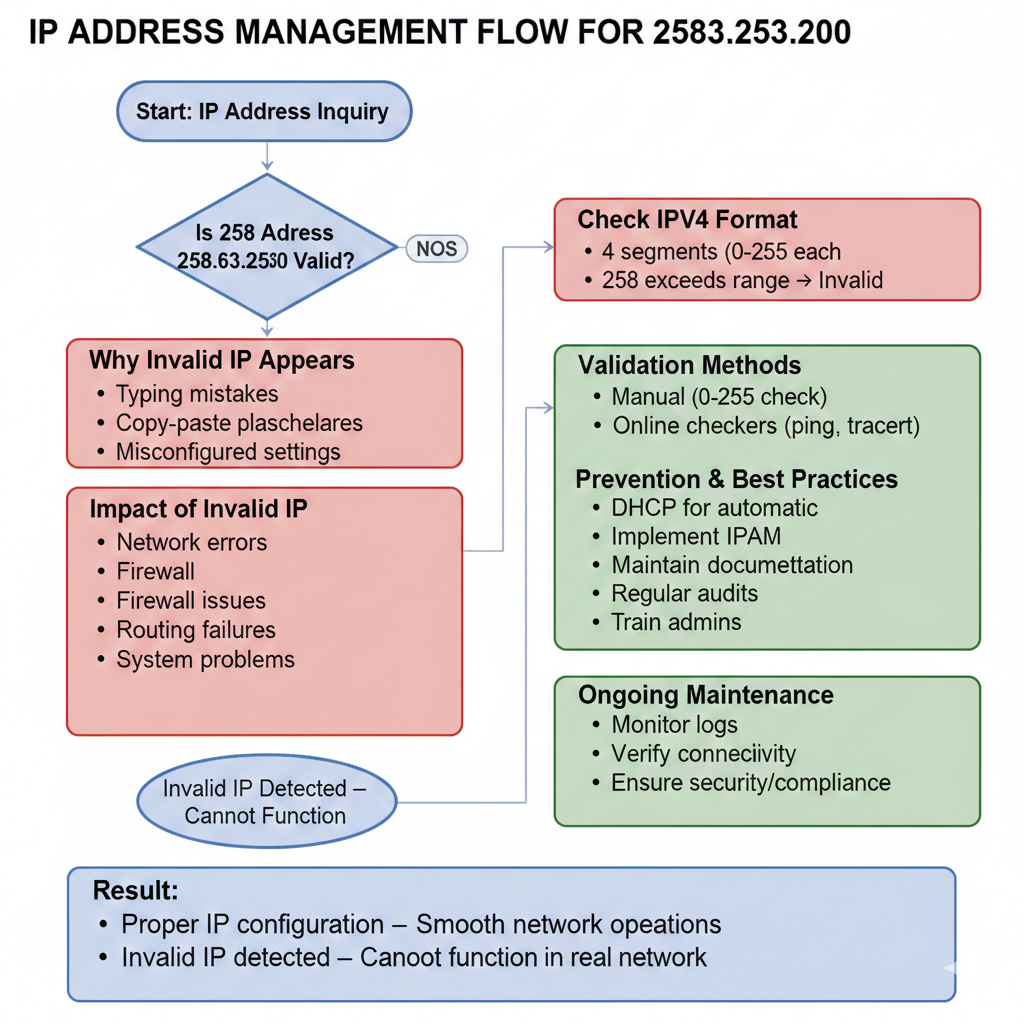
Understanding 258.63.253.200
When I first searched about 258.63.253.200, I realized that even small mistakes in IP addresses can disrupt network communication. This IPv4 identifier may appear in logs or forums, but it’s considered invalid because it exceeds the numeric range that IPv4 addresses can qualify for. Every device connected to the internet needs a unique IP to enable connectivity and data packet routing, but incorrect or incorrectly formatted entries break this smooth digital communication.
From my experience managing multiple systems, correctly formatted IP addresses are critical. Missteps in system configuration or network settings can make even valid addresses fail verification, affecting performance, security, and overall network operations. Understanding how address validity works is essential: the guide to correct IP configuration explains why combinations outside the range simply cannot function.
In practice, maintaining smooth network communication means constantly checking device connectivity, data routing, and packet flows. It’s not just about trying to assign IP addresses, but also understanding why invalid entries appear, how they affect system performance, and what verification steps matter to ensure security. In our digital world, these needs are ongoing, and even an expert must stay vigilant to keep networks connected and operational.
What Is 258.63.253.200?
At first glance, 258.63.253.200 may look normal, but understanding the IPv4 protocol reveals why it fails validity checks. An IPv4 address is a four-part number defined by the Internet Protocol, serving as a unique identifier for devices connected within a network infrastructure. Each segment requires proper IP formatting to stay within the range of 0.0.0.0 to 255.255.255.255, yet 258.63.253.200 exceeds this limit and becomes invalid.
From my experience managing network infrastructure, even a single number outside the range rules can disrupt connectivity, emphasizing why IP addresses serve critical roles. This address, inside systems, cannot function properly, highlighting that protocol requires careful formatting and defined boundaries. Since it exceeds the limits, it fails validation and becomes a nonfunctional IP in real network operations.
What Makes an IP Address Valid or Invalid?
A valid IP address must follow correct formatting, consisting of four octets with each value between 0 and 255, recognized by the Internet Protocol. In my experience as an IT professional, even minor mistakes in system configuration or using improper tools can break these rules, causing network errors, connectivity issues, and other misconfigurations. Verification is essential for administrators and IT professionals to ensure accepted IP addresses occur correctly in any network, preventing recurring problems that disrupt performance.
Why 258.63.253.200 Is Not a Real IP Address
The IPv4 protocol stores each octet in 8 bits, which limits values to 255. 258.63.253.200 exceeds these allowed limits and therefore cannot exist in real network operations. In my experience managing business and home networks, routers and servers cannot assign or perform routing processes for such an IP, and DHCP cannot handle its assignment. Firewalls cannot filter it correctly, making 258.63.253.200 non-routable in any practical network, highlighting why adherence to range and protocol rules is critical even for short experiments or tests.
How IP Address Ranges Work
Understanding IPv4 addresses requires knowing that they exist within structured ranges. Some IPs are public, meant for the internet, while others are private, reserved for network management or testing purposes. A universal numeric rule remains the same: all addresses must fall between 0.0.0.0 and 255.255.255.255. Anything outside this address range, like 258.63.253.200, automatically fails validity checks. From personal experience, strict adherence to these ranges ensures smooth network operations and prevents conflicts, making IPv4 management predictable and reliable in both public and private environments.
Why Invalid IPs Appear Online
You may often see invalid IP addresses online due to simple typing mistakes, copy-paste errors, or manual configuration issues. In my experience managing IT infrastructure, corrupted logs, software bugs, and incorrect documentation or placeholder examples in forums can also lead to confusion. Even advanced tools or checkers sometimes flag addresses incorrectly during troubleshooting requests, highlighting that human and system errors combine to make invalid IPs appear more frequently than expected.
You May Also Like: Boelis
The Role of IP Addresses in Modern Networking
IPs and IP addresses enable identification of every device across networks, allowing data packet routing between servers and devices efficiently. Accurate IP addresses support geolocation services, regional content delivery, and firewall protection, ensuring network security and cybersecurity. From my experience managing networks, without proper IP monitoring and control, access issues arise, performance suffers, and services cannot operate reliably, highlighting why IPs remain the backbone of internet operations today.
How to Validate an IP Address Correctly
To confirm an IP address validity, you can use online checker tools or run a ping command and tracert to trace routes across the network. Dynamic Host Configuration Protocol (DHCP) can assign IPs automatically, reducing errors from manual configuration. Following these steps helps prevent downtime, improve system reliability, and ensures accurate checking, while letting tools and commands verify address validity efficiently in real-world environments.
Common Issues Caused by Incorrect IP Addresses
An invalid IP address can cause connectivity issues, application access failures, and network errors. Broken routing processes and misconfigured firewall rules increase the risk of unauthorized access. In my experience managing business networks, such mistakes impact daily operations, highlighting that even a single IP address misconfiguration can disrupt entire networks and critical workflows.
Troubleshooting IP Address Errors
An effective troubleshooting process begins by rechecking IP address formatting and verifying the range. Avoid faulty manual configuration by enabling DHCP assignment and inspecting firewall protection rules. Monitoring logs for suspicious activity ensures the network infrastructure remains stable. From my experience, this approach not only fixes errors quickly but keeps systems reliably operational.
Security Considerations for IP Addresses
Improper IP handling exposes networks to vulnerability exposure and unauthorized access, creating weak internet security and risky cybersecurity gaps. Regular monitoring, updated firewall protection, and strong awareness reduce potential threats. In my experience, even small lapses in IP management can quickly compromise entire systems, making proactive security essential.
Why IP Address Accuracy Matters for Privacy
Accurate IP addresses can reveal a user’s network identity and approximate location through geolocation services, but incorrect or exposed IP information can compromise privacy and weaken management. In my experience managing enterprise IP systems, maintaining proper IP addresses protects both personal and organizational data, ensuring secure operations without accidental exposure.
Best Practices for IP Address Management
Implementing IPAM (IP Address Management) systems helps automate allocation using DHCP while ensuring you maintain proper documentation. From personal experience training network administrators, applying best practices during audits ensures a secure, efficient IT infrastructure with minimal errors, supporting long-term stability and reliable network operations.
Conclusion
An invalid IP address often breaks IPv4 range rules and can unexpectedly appear in logs or discussions, yet it cannot function in real network communication. From my experience, understanding its validity and applying proper verification and management best practices ensures stronger connectivity, higher cybersecurity, and reliable internet security across a connected world.
FAQs About 258.63.253.200
Is 258.63.253.200 a valid IP address?
The IP address 258.63.253.200 is invalid because one of its IPv4 segments, specifically 258, exceeds the allowed range of 0 to 255. Such an address cannot exist in a real network communication, making it impossible to function like properly formatted IPs do. From experience, spotting these anomalies early prevents confusion in system logs and network management.
Why does 258.63.253.200 appear online or in system logs?
Sometimes, invalid IP addresses like 258.63.253.200 appear in logs or forum discussions due to simple typing mistakes, copied examples, or placeholder IPv4 segments that exceed the allowed range of 0 to 255. Even if the address cannot exist in a real network communication, it may show up when settings are misconfigured or files are corrupted, though the system tries to handle them. In my experience, seeing these anomalies often signals the need for careful network verification and cleaning of test data.
How can I check if an IP address is valid?
To verify an IP address, you can do it manually by ensuring each segment falls between 0 and 255, which is the acceptable range. Online checkers also help, and network commands like ping or tracert can automatically reject invalid IPs, giving you quick confirmation. From my experience, combining both manual checks and online tools provides the most reliable results without impacting the network.
Can an invalid IP address cause network errors?
Incorrect or invalid IP addresses can cause connectivity issues and routing failures, often leading to system configuration errors. They may also interfere with firewall rules and network security monitoring, which impacts performance. In my experience managing enterprise networks, even a single misconfigured IP can disrupt multiple network processes, highlighting the need for careful verification and continuous oversight.
What is the best way to avoid IP address configuration mistakes?
Using DHCP for automatic IP assignment helps prevent manual configuration errors. In larger networks, Address Management (IPAM) tools ensure accurate tracking and proper allocation of IPs, which ensures smoother operations. From my experience, combining DHCP with IPAM not only prevents mistakes but also reduces downtime, making network administration far more efficient and reliable.